Печь для термообработки газовых баллонов
A heat treatment furnace for gas cylinders is a specialized industrial heating system designed to improve the mechanical properties, safety, and service life of pressure vessels. It is widely used in the manufacturing and reconditioning of gas cylinders made of steel or other high-strength metals. The furnace plays a critical role in processes such as stress relieving, normalizing, tempering, and solution treatment, depending on the material and the required performance standards.The main purpose of this furnace is to heat gas cylinders to a controlled temperature and hold them for a specific time before cooling them under a prescribed condition. This thermal process helps eliminate internal stresses created during welding, forming, or machining. It also improves the uniformity of the metal structure, reduces brittleness, and enhances toughness and durability. For gas cylinders that must withstand high internal pressure and repeated use, heat treatment is an essential step to ensure safety and reliability.A typical heat treatment furnace for gas cylinders is designed for high efficiency, accurate temperature control, and stable operation. It usually consists of a heating chamber, insulation materials, temperature control system, loading and unloading devices, and safety protection components. The heating chamber is engineered to provide even temperature distribution so that every cylinder receives consistent treatment. The insulation layer helps minimize heat loss and reduce energy consumption. Advanced control systems allow operators to set heating curves, soaking times, and cooling schedules with high precision.There are different types of furnaces used for gas cylinder heat treatment, including batch furnaces, tunnel furnaces, and continuous furnaces. Batch furnaces are suitable for smaller production volumes or varying cylinder sizes. Continuous furnaces are ideal for large-scale production, allowing cylinders to move steadily through different heating zones. Some furnaces use electric heating, while others rely on gas firing, depending on local energy availability and cost considerations. Each type offers specific advantages in terms of productivity, temperature uniformity, and operating cost.Safety is a major concern in gas cylinder heat treatment. Since the cylinders are pressure-containing components, the furnace must be built and operated according to strict industrial standards. Overheating, uneven heating, or improper cooling can damage the metal structure and reduce the strength of the cylinder. Therefore, reliable sensors, alarms, and automatic shutdown functions are often included to prevent accidents and maintain process stability.In modern production lines, heat treatment furnaces are often integrated with automated loading systems, conveyor mechanisms, and digital monitoring tools. This improves efficiency, reduces labor intensity, and enhances process repeatability. Data logging and remote monitoring also make it easier to track temperature history and ensure product traceability.In summary, a heat treatment furnace for gas cylinders is an important piece of equipment that ensures cylinders meet strict quality and safety requirements. By providing precise and uniform thermal processing, it helps improve material properties, extend service life, and support safe use in industrial and commercial applications.
продукт
классификация:
-
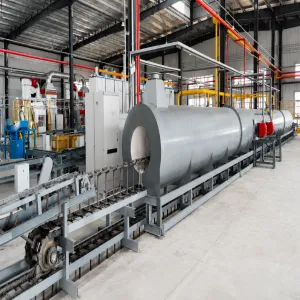
Печь для термообработки газовых баллонов
Их классификация:
Линия по производству газовых баллонов
мнения:
211
номер:
Время выпуска:
2026-06-22 17:08:47
1, Высокая производственная мощность до 50 т/ч (тип шагающей балки); 250 ед./ч (цепной конвейерный тип); охватывает отжиг, нормализацию, закалку и отпуск
2. Точный контроль температуры. Точность ±5°C, однородность ±5°C по всей длине; соответствует GB/T 9452 и TSG 07; зональное импульсное горение предотвращает прямое попадание пламени на детали
3, Превосходная изоляция Модульная конструкция коробчатого типа; высокотемпературные отливки, прочный кирпич и изоляция из алюмосиликатного волокна обеспечивают низкий рост температуры корпуса
4. Жаростойкая система привода. Редуктор с частотно-регулируемым приводом, высокотемпературными звездочками и цепями; Опоры из нержавеющей стали (диаметр 22 мм, расстояние между ними 150 мм) обеспечивают долговременную стабильность при температуре 600°C
5. Эффективное сжигание. Высокоскоростные горелки мощностью 150 000 ккал/ч; трехзонное импульсное управление; точная регулировка соотношения воздух-топливо сводит к минимуму образование накипи
6. Полностью автоматизированный ПЛК Siemens с 15-дюймовым сенсорным экраном; интеграция РСУ; хранение и отслеживание данных; режим ручного резервного копирования доступен при аномалиях ПЛК
7. Рекуперация отходящего тепла и интеллектуальная линия. Отходящее тепло дымовых газов предварительно нагревает воздух для горения; совместимость с закалочными емкостями, поточным измерением твердости и загрузкой данных для удовлетворения требований интеллектуального производства
8. Экологичное и энергоэффективное импульсное сжигание экономит 10–15% энергии; утилизация отходящего тепла; поддерживает отопление природным газом, электричеством или угольным газом; отсутствие утечки дымовых газов; Соответствует ISO14000
новости
классификация:
Нет результатов поиска!
случай
классификация:
Нет результатов поиска!
видео
классификация:
Нет результатов поиска!
скачать
классификация:
Нет результатов поиска!
вербовка
классификация:
Нет результатов поиска!
Рекомендуемые продукты
Нет результатов поиска!





 English
 Español
 Français
 العربية



 телефон