

Контактная информация:
+86 17852488518

Product Overview
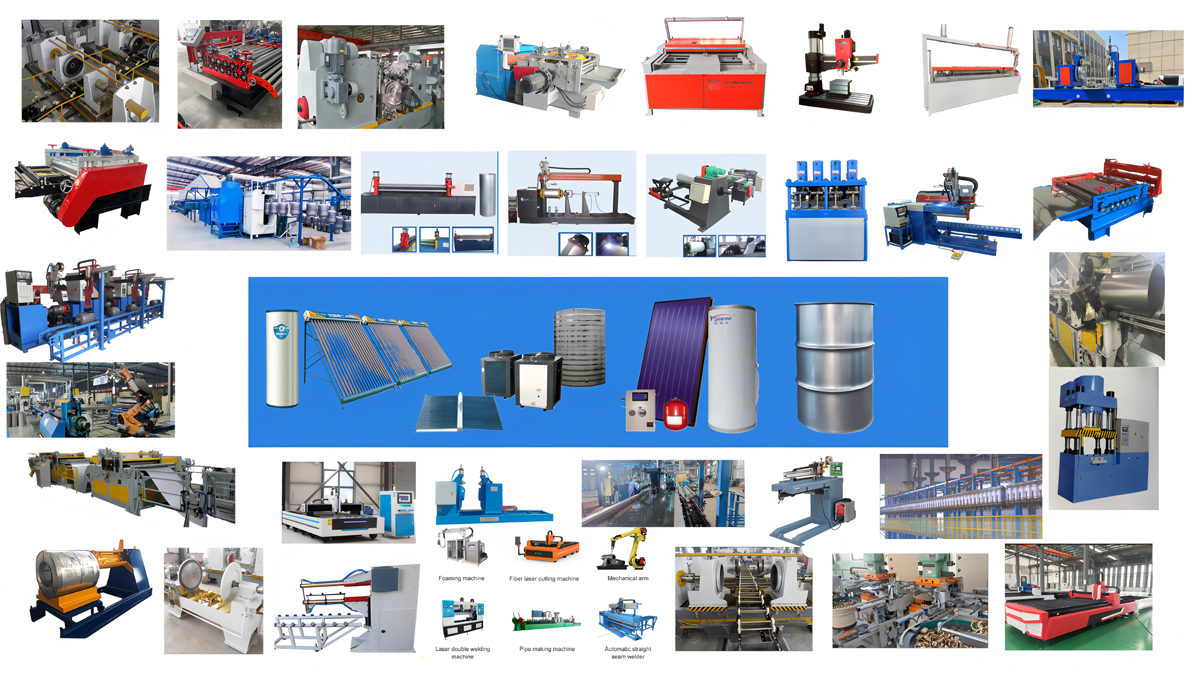
The Automatic Steel Drum Straight Seam Welding Machine is a key welding unit in a complete Steel Drum Production Line, specially developed for joining the longitudinal edges of drum bodies after rolling and forming. It is mainly used for manufacturing 200L (55-gallon) steel drums, chemical barrels, lubricant containers, and other industrial metal packaging products. The machine adopts advanced resistance welding technology, precision welding electrodes, automatic positioning devices, and PLC control systems to ensure strong, uniform, and reliable seam welding performance. It supports different steel sheet thicknesses and drum specifications through adjustable welding current, welding speed, and pressure parameters, providing excellent adaptability for various production requirements. With a robust machine frame, stable transmission structure, high welding accuracy, low energy consumption, and easy operation, the equipment ensures continuous and efficient production. The straight seam welding machine can be integrated with drum rolling machines, corrugation machines, flanging machines, and seaming machines to build a complete automatic steel drum manufacturing line. Widely used in chemical, petroleum, paint, coating, food, and industrial packaging industries, it helps manufacturers improve production efficiency, reduce labor costs, and achieve consistent drum quality. Tai'an Lishen Machinery Technology Co., Ltd. provides customized welding equipment solutions, production line integration, installation support, and technical services according to customer needs.


You know that sinking feeling when a customer calls to say your drums are leaking? I've been there. And in almost every case,
the problem traces back to the same place: the longitudinal seam weld. That's the long weld that runs from top to bottom of
the drum body, and if it's not done right, nothing else matters.
Here's the thing about steel drum manufacturing that surprises a lot of people. The straight seam weld is one of the two most
common places where steel drums leak. The other is where the lid meets the body. But the seam weld is the foundation. If
that weld has pinholes, weak spots, or inconsistent penetration, your drum will leak—guaranteed.
A steel drum longitudinal seam welding machine uses resistance welding to join the overlapped edges of the drum body. Two
electrode wheels apply pressure and current, heating the metal until it melts and fuses together. The result should be a
continuous, leak-proof joint that's strong enough to survive shipping, stacking, and handling.
When you're shopping for a seam welder, the first big question is: semi-automatic or fully automatic? A semi-automatic
machine requires an operator to feed the drum body through the welding heads. That works fine for lower-volume
production. But here's the catch—the weld quality depends on how steady the operator's hands are. If they're tired or
distracted, the weld can wander, and you'll get weak spots.
A fully automatic Longitudinal Seam Welder handles everything automatically. The drum body is positioned, clamped, welded,
and released without manual intervention. PLC control systems manage the welding current, wheel pressure, and speed
consistently on every drum. Some advanced machines even include automatic seam finding using laser sensors, so the
welder always starts at exactly the right spot.
Another key consideration is the power source. Many older seam welders use AC (alternating current) transformers. But
newer machines are switching to medium frequency inverter DC (MFDC) technology. MFDC gives you more stable weld
current, less spatter, and better weld quality—especially on thinner or coated steels.
Here's a practical tip I've picked up from working with seam welders: pay close attention to the electrode wheels. These
copper wheels carry the welding current and apply pressure to the seam. They wear over time, and when they wear unevenly,
the weld quality drops. Regular dressing—using a special tool to resurface the wheels—keeps your weld quality consistent.
One more thing: check the overlap width. The edges of the drum body need to overlap by about 4 to 6 millimeters before
welding. Too narrow, and the weld won't be strong enough. Too wide, and you're wasting material. A good seam welder will
have adjustable guides to maintain that overlap consistently.
At the end of the day, your steel drum longitudinal seam welder is one of the most important machines on your line. It's the
machine that turns a rolled sheet of steel into a strong, sealed drum body. And if it's not running at its best, your leak tester
will find out soon enough.


Этот веб-сайт использует файлы cookie, чтобы обеспечить вам максимально эффективное использование нашего веб-сайта.


 English
 Español
 Français
 العربية



 телефон