

Контактная информация:
+86 17852488518

Product Overview
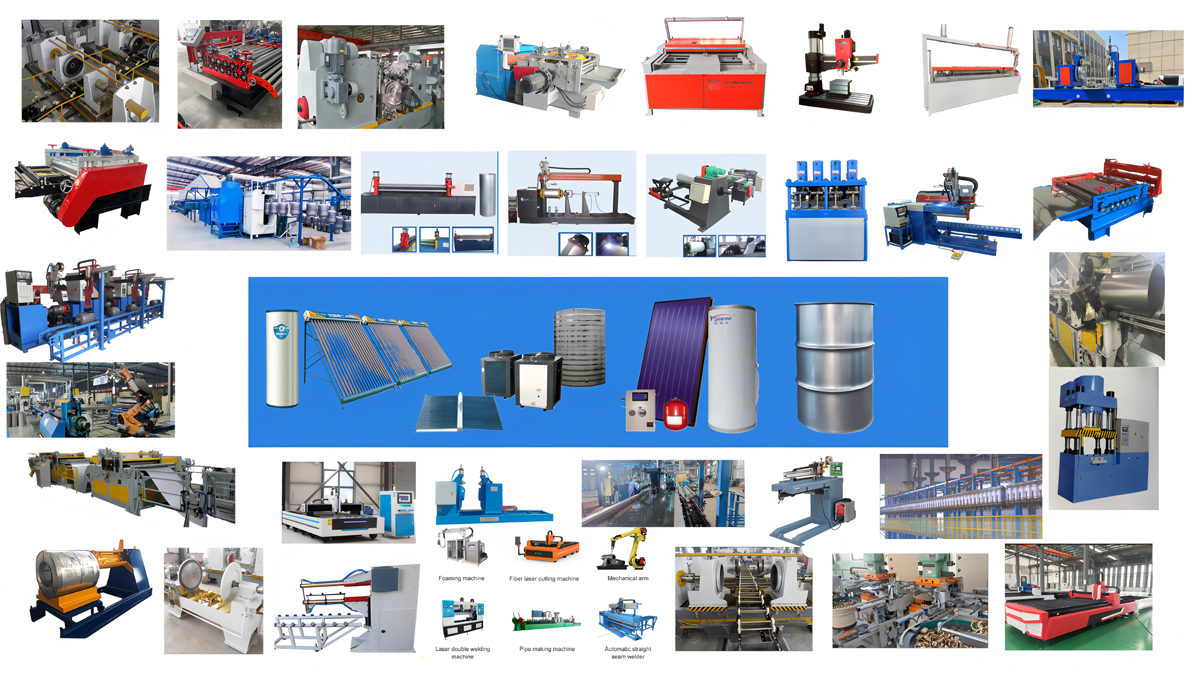
The Automatic Steel Drum Corrugation Machine is an important forming equipment in a complete Steel Drum Production Line, mainly used for processing reinforcing ribs on the surface of 200L (55-gallon) steel drums and industrial metal barrels. The machine adopts precision corrugation rollers, hydraulic forming technology, automatic positioning system, and PLC intelligent control to create uniform and accurate corrugated patterns on drum bodies, improving the strength, impact resistance, and structural stability of steel drums. It is suitable for different drum diameters, steel plate thicknesses, and production requirements, with adjustable corrugation depth and spacing for flexible operation. Featuring a strong machine structure, stable transmission performance, high processing accuracy, low energy consumption, and easy maintenance, the equipment ensures reliable operation during continuous production. The steel drum corrugation machine can be integrated with drum rolling machines, seam welding machines, flanging machines, and seaming machines to form a complete automatic steel drum manufacturing line. Widely used in chemical, petroleum, lubricant, paint, coating, and industrial packaging industries, it provides efficient and durable solutions for improving drum quality and production efficiency. Tai'an Lishen Machinery Technology Co., Ltd. offers customized equipment design, production line integration, installation guidance, and technical support according to customer requirements.


When I first started working with steel drum manufacturers, I used to think the welding machine was the most important
piece of equipment on the line. After all, a bad weld means a leaking drum, right? But then I spent some time watching what
happens to drums after they leave the factory. They get stacked three or four high in warehouses. They get bumped and
jostled during shipping. And the ones that survive best aren't always the ones with the prettiest welds—they're the ones
with the strongest bodies.
That's where your **Steel Drum Beading Machine** comes in. Sometimes called a corrugating machine or W-beamer, this
equipment rolls those distinctive ring-shaped ridges into the drum body . And those ridges? They're not just decoration.
They're what keeps a thin steel cylinder from crumpling under the weight of the drums stacked on top of it.
Here's the thing about beading that a lot of people don't realize. A steel drum body is basically just a thin metal tube.
Without reinforcement, it's surprisingly easy to crush. But add a few well-placed ridges—what the industry calls W-beams or
corrugations—and suddenly that same tube can handle a lot more weight. The beading machine creates those ridges by
pressing specially shaped rollers against the rotating drum body, forming precise, uniform grooves that add stiffness
without adding material weight .
There are different ways to do this. Some machines are hydraulic, using fluid pressure to control the forming force. Others
are fully mechanical, with cam-driven heads that move into position . A good example of the mechanical approach is the
Grotnes W Beader, which uses two forming heads with both inside and outside forming rolls. The inside rolls are powered,
while the outside rolls follow along on bearings, all synchronized for smooth forming .
If you're shopping for a steel drum beading machine, here are a few things to pay attention to:
Cycle time matters. A good beading machine should complete each cycle in around 3 to 5 seconds. On the Grotnes machine,
for example, the estimated beading cycle time is about 3.8 seconds . That's fast enough to keep up with a medium-speed
production line.
Tooling changeover speed is important too.If you're running multiple drum sizes, you'll be swapping tooling often. Look for
a machine where die changes can be done in minutes, not hours. Some modern machines can handle different diameters
and bead profiles with adjustments taking less than 10 minutes .
Versatility can save you money. Some advanced beading machines can do more than just one type of ridge. With optional
tooling, they can create corrugations, ISO beads, or combinations of both . A combination flanger-curler-beader can even
handle multiple forming operations in a single setup, which saves floor space and reduces handling .
One practical tip from my experience: don't overlook the importance of adjustable bead depth and position. Different drum
designs need different bead profiles. A good machine lets you adjust the depth and location of the beads precisely, often
through a PLC or touchscreen interface .
Your steel drum beading machine may not get the same attention as the welder or the seamer, but it's the machine that
gives your drums the strength to survive the real world. And in this business, that's what keeps customers coming back.


Этот веб-сайт использует файлы cookie, чтобы обеспечить вам максимально эффективное использование нашего веб-сайта.


 English
 Español
 Français
 العربية



 телефон