

Контактная информация:
+86 17852488518

Product Overview
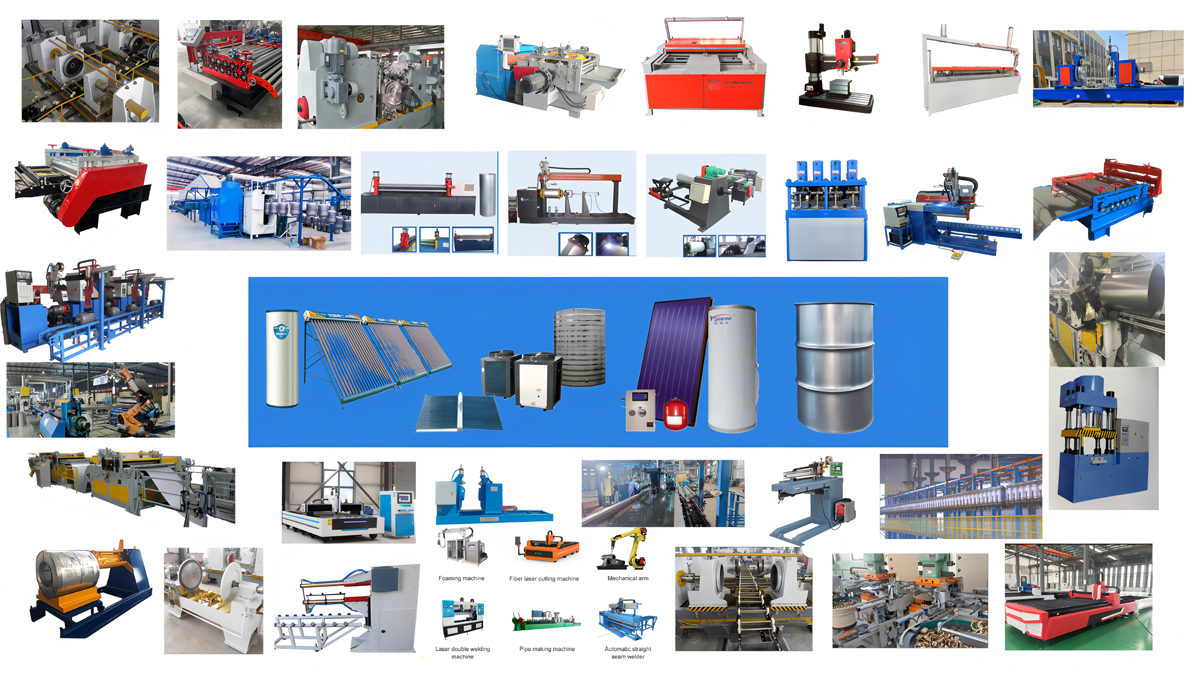
The Automatic Small Metal Drum Lid Making Machine is specially designed for manufacturing covers and lids of 10L–60L small steel drums, paint buckets, chemical containers, and metal packaging products. The equipment integrates multiple processes including automatic sheet feeding, punching, stretching, forming, trimming, and edge shaping to achieve efficient and precise lid production. Equipped with a reliable hydraulic or mechanical drive system, precision molds, automatic feeding device, and PLC control technology, the machine ensures stable operation, accurate forming dimensions, and consistent product quality. It supports different materials such as galvanized steel sheets, tinplate, and cold-rolled steel plates, and can be customized according to various lid sizes and production requirements. With advantages of high automation, simple operation, low maintenance cost, and long service life, the equipment is widely used in industries such as paint, coating, chemical, lubricant, food, and household metal packaging. Tai'an Lishen Machinery Technology Co., Ltd. provides customized small drum lid production solutions, including mold design, equipment integration, installation support, and technical service to help customers achieve efficient and reliable metal container production.


Let me tell you about something that doesn’t get nearly enough attention in steel drum manufacturing: the lid. Most people
focus on the drum body—the curling, the welding, the seaming. But if your lids aren’t right, your drums aren’t right. And if
you’re making smaller steel drums—say, 10 to 60 liters instead of the big 200-liter ones—your lid-making equipment needs
to be just as precise as the rest of your line.
In the steel drum business, lids aren’t just flat circles of metal. They need to be stamped, curled, sometimes have a flange
formed around the edge, and often require a closure flange or bung hole installed. And if you’re making small drums for
paints, chemicals, or food products, those lids have to seal perfectly. That’s where small drum lid-making equipment comes
in, sometimes called a lid forming press or cover manufacturing system.
Smaller drums have tighter tolerances. With a 200-liter drum, a millimeter off in lid diameter might not be a huge issue. But on
a 10-liter drum, that same millimeter could mean the difference between a perfect seal and a leak. So when you’re choosing
lid-making equipment for smaller drums, precision becomes critical.
Here’s what I’ve learned from helping factories set up small drum production lines. First, a good lid-making system usually
starts with a decoiling and leveling unit to feed the steel coil smoothly. Then a stamping press—often a hydraulic press with
four columns for rigidity—does the blanking and drawing to form the lid shape. This can be a single operation or multiple
stages, depending on whether you’re making simple flat lids or complex ones with flanges.
Some lines use a separate beading or flanging machine to curl the lid edge before it goes to the seamer. And here’s the
important part: the tooling changeover has to be fast. Small drums come in a lot of sizes—10L, 20L, 25L, 50L. If it takes you
two hours to swap dies, you’re losing a lot of production time.
One practical tip from my experience: always check the adjustability of the lid forming press. A good press will let you change
the stamping depth and pressure with a few button presses, not a wrench and a lot of frustration. And if you’re buying a
press, look for one that can handle a range of lid diameters—maybe from 200mm to 400mm—so you have the flexibility to
run multiple products.
Another thing that’s easy to overlook: the lid stacking system. You can stamp lids all day, but if they’re piling up in a messy
stack, you’ll waste time sorting them before they go to the seamer. A good lid-making line will have an automatic stacker
that neatly organizes the lids and feeds them directly to the next station.
Your small drum lid-making equipment may not take up the most floor space, and it may not be the biggest investment in
your production line. But it’s the equipment that makes one of the most critical parts of your drum—and that’s a part
that’s worth getting right.


Этот веб-сайт использует файлы cookie, чтобы обеспечить вам максимально эффективное использование нашего веб-сайта.


 English
 Español
 Français
 العربية



 телефон